How Nature Boosts Children’s Health, Focus, and Academic Growth
More than 100 years ago, Maria Montessori understood that time in nature supports a child’s development, and today’s research backs her up. Pedagogic studies worldwide show that outdoor experiences strengthen children’s physical health, capacity for learning, and emotional well-being. Neuroscience confirms that sensory exploration, physical independence, and self-directed movement activate the brain systems needed for focus and decision-making. Montessori built such sensory experiences, freedom to choose, and purposeful movement into daily learning from the start. For us, outdoor education is simply that same approach carried into the natural world.
Physical Health: Strengthening the Body Naturally
Outdoor activity builds children’s physical confidence in many more ways than indoor gym time. Activities such as climbing, digging, and collecting develop muscles, coordination, and spatial awareness. Sunlight boosts Vitamin D levels and strengthens immunity. Children who regularly explore and learn outdoors show improved endurance, better sleep, and fewer sick days.
Even simple acts — hauling water to a garden bed, hiking a gentle trail, or digging for worms — provide proprioceptive input that reinforces instincts of balance and motor control. The body learns through experiential feedback and outdoor activity provides endless possibilities for such experiences.
Emotional and Mental Wellbeing
Just 30 minutes outside can offer a child significant emotional benefits. Studies show that natural environments reduce cortisol (the stress hormone) and restore attention, leading to reduced stress, anxiety, and anger. Children who are restless or tense indoors are soothed and calmed by the multi-sensory outside environment. The combination of movement, bright sunlight, and unstructured exploration helps physical regulation of emotions, nurturing self-directed confidence.
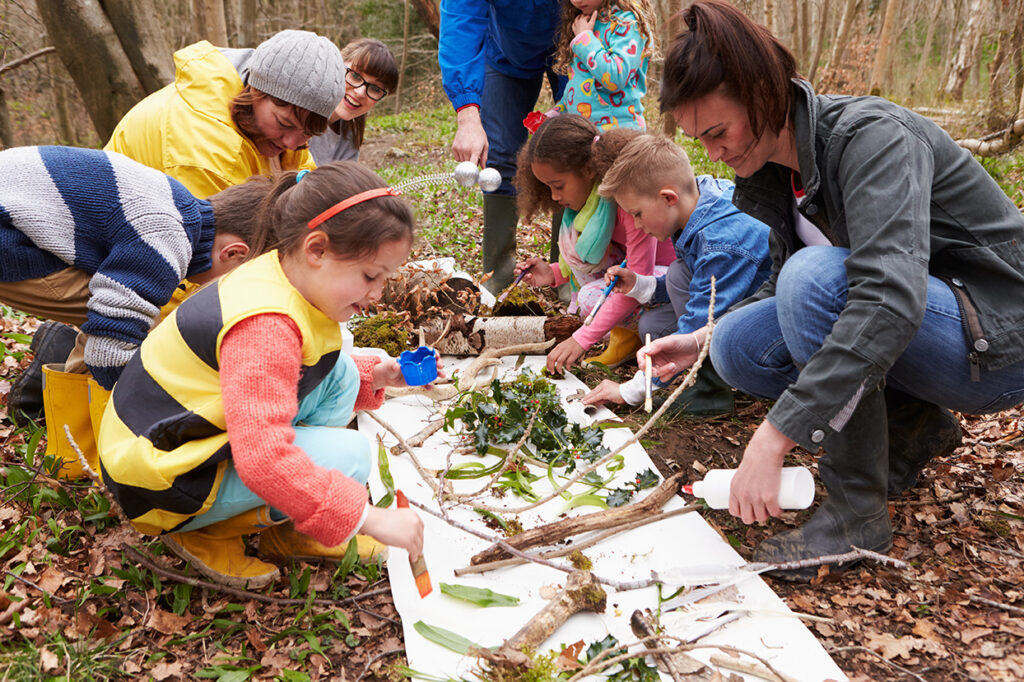
The Montessori approach allows students their freedom of choice in outdoor work. They might choose to gather data for a science project or sketch in a nature journal. They can choose just to quietly observe the world around them. Such autonomy fosters confidence and resilience. Students develop greater capacity for awe, empathy, and prosocial behavior. In this way, activities in nature promote self-regulation and emotional independence–two pillars of lifelong wellbeing.
Academic and Cognitive Benefits
With dwindling test scores, many schools decreased recess to increase learning time in hopes of improving academic outcomes. Yet, the evidence from research overwhelmingly supports the opposite: increasing outdoors time enhances academic performance. Such benefits are multiplied when students engage in nature-based lessons. They demonstrate stronger concentration, longer time-on-task, and deeper conceptual understanding — critical to optimal academic performance.
When children study nature firsthand, they ask deeper questions and improve conceptual memory and recall. A lesson on plant anatomy becomes more tangible when a student collects a leaf outside before dissecting it and sketching its veins in the classroom.
Outdoor activities sharpen observation, pattern recognition, and problem-solving. These are the same cognitive skills that underlie math and science achievement. The outdoors also cultivates creativity, as open-ended environments invite experimentation and imagination.
Closing Reflection: The Whole Child in Balance
Perhaps the greatest scientific endorsement of outdoor learning is its holistic effect. It strengthens the body, calms the mind, and ignites curiosity — nurturing not one part of the child but the whole being.
➡️ Next week: Part 3 – Making Autumn Count, where we’ll explore simple ways families and teachers can bring these outdoor lessons to life.
🔗 Part 1: If you missed the first part of our When Nature Becomes the Teacher series, Part 1: How Nature Boosts Children’s Health, Focus, and Academic Growth
🌟 Discover how Montessori learning connects health, science, and joy. Visit our campus gardens and outdoor classrooms, meet our teachers, and observe how our students learn. Schedule a tour today.
References & Further Reading (Part 2)
- Lee, EY., de Lannoy, L., Kim, YB. et al. (2025) Position statement on active outdoor play. Int J Behav Nutr Phys Act 22, 117. https://doi.org/10.1186/s12966-025-01813-9
- Patchen, A. K., Edwards, A., Rakow, D. A., & Meredith, G. R. (2024). Supporting children’s wellbeing through outdoor time: opportunities to integrate consistent outdoor time into the elementary school day. Frontiers in Public Health, 12, 1483862. https://doi.org/10.3389/fpubh.2024.1483862
- Mann, J., Gray, T., Truong, S., Brymer, E., Passy, R., Ho, S., Sahlberg, P., Ward, K., Bentsen, P., Curry, C., Cowper, R. (2022). Getting Out of the Classroom and Into Nature: A Systematic Review of Nature-Specific Outdoor Learning on School Children’s Learning and Development. Frontiers in Public Health, 10, Article 877058. https://doi.org/10.3389/fpubh.2022.877058
- Green Schoolyards America. (2020). Spending Time Outside in Nature has Physiological Benefits. Retrieved November 5, 2025, from https://www.greenschoolyards.org/nature-benefits-physiological
- May River Montessori. (2023). The Power of Outdoor Learning in Montessori Education. Retrieved November 5, 2025, from https://www.mayrivermontessori.com/the-power-of-outdoor-learning-in-montessori-education
- Montessori Tides School. (n.d.). Nature Study in Montessori Learning. Retrieved November 5, 2025, from https://www.montessoritides.com/nature-study/